

SERVICES

PRODUCTS
INDUSTRIES
RESOURCES
COMPANY
How Abaad Investments Group consolidated operations across manufacturing, distribution, mining, and property management using a unified ERP architecture.
CLIENT
Abaad Investments Group
INDUSTRY
FMCG, Wholesale & Distribution, Mining, Property Management
SYSTEMS REPLACED
Legacy systems, spreadsheets, manual workflows
PRIMARY PLATFORM
Oracle NetSuite
ENTITIES STRUCTURED
7+ operating subsidiaries
GEOGRAPHY
Oman (MENA)
Multi-industry, multi-entity operational fragmentation with limited financial visibility
Architecting a unified ERP platform to manage multi-industry operations, consolidate financial reporting, and establish inventory and supply chain visibility across a diversified conglomerate.
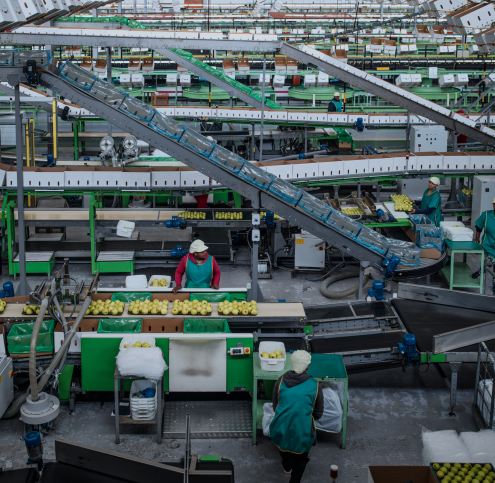
As Abaad Investments Group expanded across multiple industries including bottled water production, food distribution, mining operations, and property management, the complexity of managing operations across the group increased significantly. Each subsidiary operated using separate systems and manual processes, resulting in fragmented data visibility and limited coordination across finance, supply chain, and operational teams. With increasing inventory movement, growing customer demand, and expanding facilities, leadership faced mounting pressure to establish a unified platform capable of supporting both operational scale and financial governance across the group.
The group was approaching a structural inflection point:
To address these challenges, Abaad partnered with Vantheon Technologies to implement NetSuite, a unified cloud-based ERP platform capable of consolidating financial operations, integrating supply chain management, and delivering real-time operational visibility across all entities.
The priority was not simply to replace legacy systems, but to establish an operational architecture capable of supporting Abaad’s continued expansion across multiple industries under a single governance model.


This transformation required deeper architectural intervention beyond configuration.
A centralized financial structure was built to support:
This reduced material leakage risk and strengthened supply chain visibility.

 Manual processes significantly reducedInventory visibility increased across locationsWorkflow automation improved order processing speedCross-department coordination streamlinedReduction in reconciliation effort across subsidiaries
Employees shifted focus from administrative reconciliation to operational value creation.
Centralized consolidation improved reporting accuracyIntercompany controls reduced reconciliation riskEnhanced audit readinessStronger oversight across 7+ subsidiariesThe system moved Abaad from reactive reporting to structured financial governance. The ERP architecture now supports Abaad's ability to manage manufacturing, distribution, mining, and property operations within a single governance framework.
“KPI's expertise in cloud-based ERP systems helped us identify gaps and develop a tailored solution addressing our specific needs. We worked with a very knowledgeable technical team who facilitated a smooth transition from our legacy systems to NetSuite. With user-friendly workflows, inter-company collaboration, and extended support, our partnership with KPI and NetSuite has been a huge win for our business.”

The priority was not simply to replace legacy systems, but to design an ERP architecture capable of supporting continued expansion across industries without introducing reporting fragmentation or governance risk. The architecture implemented ensures scalability – whether through new subsidiaries, expanded warehousing, or regional growth.
Multi-industry conglomerates often experience operational fragmentation as they expand across sectors and subsidiaries. Systems are introduced incrementally to support local operational needs, but over time this results in fragmented reporting structures and limited financial visibility at the group level. ..Read more
When diversified enterprises scale, operational complexity compounds. The advantage lies not in adding systems, but in architecting control. If your organization is navigating multi-entity growth, speak with our team about designing the right ERP architecture.